
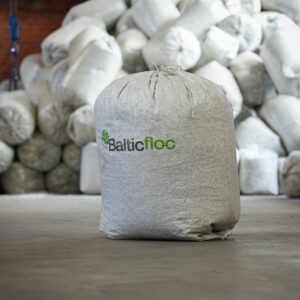
Blaticfloc Grand Full Polystyrene Granules
Polystyrene granules are a loose-fill thermal insulation material designed to fill enclosed air gaps and hollow cavities in building structures. Their small size and low weight allow them to reach narrow or irregular spaces, making Grand Full particularly useful for improving insulation in existing buildings without extensive dismantling.
Where are polystyrene granules used?
Gaps can develop or remain within exterior walls when the original insulation is too thin, has settled unevenly or did not completely fill the available cavity. These uninsulated spaces create weak points where more heat can escape through the wall.
Grand Full polystyrene granules can be blown into existing enclosed cavities to fill these spaces without extensively removing the facade or interior finish. This makes them particularly useful for renovating older masonry buildings where preserving the existing exterior is important.
What makes polystyrene granules effective for insulation?
An effective cavity insulation needs to fill the available space while maintaining its volume and insulating properties over time. Grand Full combines low thermal conductivity with fine granules that can spread through narrow and irregular cavities.
Low thermal conductivity
Grand Full has a thermal conductivity (λ) of 0.034 W/(m·K). This low conductivity limits the amount of heat transferred through the insulation layer, helping reduce heat loss through exterior walls.
Dimensional stability
After installation, the granules have a settlement coefficient of approximately 0.5%. This low level of settlement helps the material retain its volume and reduces the likelihood of new uninsulated spaces developing within the cavity over time.
Effective filling of narrow cavities
The granules have a maximum diameter of 6 mm (0.24 in.), allowing them to move into narrow spaces that can be difficult to reach with boards or rolls.
This is especially useful in older buildings, where wall cavities may vary in width or contain mortar residue and other irregularities. The small granules can move around these obstructions and fill the available space more evenly.
Water vapor permeability
Water vapor diffusion resistance (μ) indicates how strongly a material resists the movement of water vapor. Grand Full polystyrene granules have a μ value of 5.
They provide more resistance to water vapor movement than mineral wool or loose-fill cellulose insulation, but considerably less than expanded polystyrene boards. This characteristic should be considered alongside the other materials in the wall when evaluating moisture management.
Longevity
Polystyrene granules resist corrosion and biological decomposition and do not significantly compact during normal service. Their dimensional stability helps the insulation layer maintain its physical properties without requiring regular replacement due to material aging.
How are polystyrene granules installed?
Grand Full is installed by blowing the granules into an enclosed wall cavity using specialized equipment. Small access holes are made in the wall, and the material is fed under pressure until it fills the available space.
Once installation is complete, the access holes can be sealed, minimizing changes to the existing facade. The blowing process also allows the installer to place the required amount of material directly into the cavity, limiting unnecessary material waste.
This installation method is one reason polystyrene thermal insulation pellets can be useful in renovation projects where opening the entire wall would be disruptive or unnecessary.
When is polystyrene granule insulation a good choice?
Grand Full is particularly suited to renovation projects where enclosed cavities in brick exterior walls need additional insulation. It can be useful when the existing facade needs to remain intact and the cavity provides enough continuous space for the granules to spread throughout the insulated area.
Polystyrene granules are not intended for every insulation project. Another insulation system may be more appropriate when:
- the structure does not contain an enclosed cavity and board or roll insulation can be installed;
- a new exterior insulation system is being constructed using insulation boards;
- a frame structure requires another insulation material or installation method specified by the manufacturer.
What affects the performance of polystyrene granule insulation?
The performance of the finished insulation depends on both the condition of the existing wall and how completely the cavity is filled. Before and during installation, it is important to ensure:
- the wall cavity is suitable for loose-fill insulation;
- enough granules are installed to fill the available volume;
- installation is controlled so the material is distributed throughout the cavity;
- access holes are properly sealed after installation to restore the integrity of the wall and facade.